
Katy Perry Family History
Overview
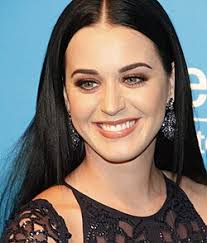
Katheryn Elizabeth Hudson, better known as the singer/songwriter Katy Perry, was born on October 25th, 1984 to Pentecostal pastors Keith and Mary (nee Perry) Hudson in Santa Barbara, California. She was the middle of their three children.
She had a nomadic early childhood as her parents crisscrossed the country, setting up new Pentecostal churches as they went. In 1995, when Katy was eleven, they returned to their home in Santa Barbara.
All the time she dutifully attended Christian schools and camps and sang in their Pentecostal-leaning church. But at the same time she thought she was “the black sheep of the family.” Her younger brother David saw her as a tomboy during her adolescence. Her secret desire was singing.
She dropped out of high school at fifteen and left Santa Barbara two years later to pursue a singing career in Los Angeles.
Singing. She started out, like other hopefuls, working in lousy jobs and getting into debt. She released her first record with a Christian theme in 2001. But it did not sell well. She remained on the fringes of the Los Angeles music scene until her breakout album One of the Boys in 2008.
What Changed? It was pop rock. She was sexy. And there was one song there, I Kissed a Girl, that was controversial and brought her oodles of publicity. She followed this up with the disco-influenced Teenage Dream. It became the only album by a woman ever to have five US number-one singles.
In 2013 the New York Times rated her “the most potent pop star of the day – her hits are relatable with just a hint of experimentation.”
Her fame grew. She hosted Saturday Night Live in December 2011. And she performed at the Super Bowl halftime show in February 2015 (her viewers were more than the number of people who actually watched the game).
Katy has since become one of the best-selling music artists of all time, with estimated sales of over 150 million records worldwide. Billboard named her as being among the greatest pop stars of the 21st century.
Katy’s Ethnicity
There is a mix here. Her mother is three eighths Portuguese, one eighth Irish, and the balance being of German, and English/British Isles origin. Her father has English and smaller amounts of Irish and Scottish ancestry.
A DNA test whose results Katy displayed on her Instagram page stated that her genetic ancestry was:
- 87% NW European, half British/Irish and half other NW European
- 11% Southern European, half Iberian and half elsewhere
- and 2% other European.
The Perry Line
On Katy’s mother’s side, three of her four great great grandparents were Portuguese and had come to America from the Azores. The fourth was a great great grandmother from Ireland.
The Portuguese Side. The Perry name here is an anglicized version of the Portuguese Pereira. The Pereira name in Portugal means “pear tree” and would probably describe someone who lived near to a pear tree or orchard. Pereira is the most common surname in the Portuguese Azores islands off the African coast.
Azorians started emigrated to the United States in the mid-19th century due to overpopulation and scarce farmland available at home. Some went to Boston and sought jobs in the Massachusetts whaling industry. Others tried California on the West Coast after news of the gold strikes there. Jacinto Pereira made his way to Hawaii in 1861.
Francisco Pereira from the island of Horta in the Azores arrived in California sometime around 1860. He adopted the name of Perry. So Francisco Pereira in time became Frank Perry. He and his Azorian wife raised five children in Alameda county near San Francisco, including their eldest son Antonio born in 1863.
The Irish Side. Katy’s Irish great great grandmother was Hannah Mulhare. She was born in 1829, one of ten children of Patrick and Sarah Mulhare from Eyrecourt in county Galway.
When the Potato Famine came to Ireland, the family decided to leave for America. They arrived in New Orleans on the Forest State in 1852 and were then drawn to California by the Gold Rush.
Hannah’s father Patrick died in California in 1858. Her brother James found work with the Pacific Express Company. However, he became involved in a theft of gold in 1859 and ended up in jail. Hannah had been engaged to his co-conspirator John Connor who was also jailed. And she herself was indicted in 1861 as a co-conspirator, but was later acquitted.
After these eventful years, Hannah married Vicente Denis from the Portuguese Azores in Sacramento in 1864 and spent the rest of her life quietly as a housewife. She may have had some of her gold squirreled away. When she died in 1895 she left $9,000 of her own money to her husband and three children.
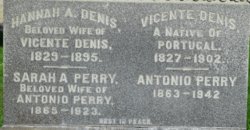
Perrys in San Francisco. Her eldest daughter Sarah married the Azorian Antonio Perry in San Francisco in 1901. They were living with their three children in the city at the time of the 1906 earthquake. By the time of the 1920 census the family had moved to Berkeley.
Their older son Vincent, born in 1901, remembered the city in flames as they were being evacuated with their possessions in a cart. Vin later involved himself in mining and worked for the Anaconda Company for forty-five years, spending much of his time in Mexico and Brazil. He ended up as the company’s Vice President for geology.
A younger daughter Eleanor, born in 1903, remained in California. She attended Berkeley College and became well-known as a modernist painter of still lifes.
Frank Joseph Perry Sr. Their younger son Frank was just one at the time of the earthquake. After World War One he went East to New York where he worked as a stockbroker during the market’s boom and bust.
He married into some money. His first wife Pauline was related to Charles M. Schwab, the Pennsylvania steelman who created Bethlehem Steel and later lived extravagantly in New York.
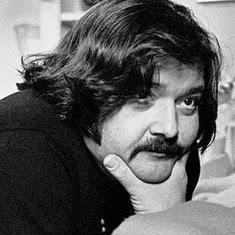
Frank and Pauline moved out to Morristown, New Jersey, Their eldest son Frank Jr, born in 1930, became a celebrated theatre and film director, best known for movies such as David and Lisa and Mommie Dearest. He was married three times.
After his divorce from Pauline, Frank Sr. married again in 1946 – to a widow Mary, also from Pittsburgh. Mary came from money too. Her grandfather Leopold Vilsack had begun life as a brewer in Pittsburgh before getting into the steel and banking business. His family mausoleum left no doubt that he made serious money.
Frank moved back to California with Mary. Their only child Mary, Katy’s mother, was born in Santa Barbara, California in 1947. Frank himself died there in 1969.
The Hudson Line
It was the Hudsons on Katy’s father’s side. They did not come to California directly like the Perrys. Instead they had Southern roots, mainly centred on Arkansas and Tennessee.
Obadiah Hudson was the first where we have definite records. The line from Obadiah to Keith Hudson, Katy’s father, went as follows:
- Obadiah B. Hudson (1836-1906)
- Joseph S. Hudson (1868-1936)
- Robert C. Hudson (1901-1983)
- Robert C. Hudson (1919-1986)
- Maurice Keith Hudson (b. 1947)
Obadiah Hudson. Obadiah was born in 1836 in McCracken county in western Kentucky. He was the son of Henry Hudson who may have been born in South Carolina; although one report has Henry coming from Scotland.
Obadiah did not stay long in Kentucky. At the age of thirteen (after his father died), he moved down south to Louisiana and worked on the steamboats for three years before briefly returning to Kentucky and marrying.
He then headed southwest to eastern Arkansas, settling in Phillips county. He was a farmer, brick mason and tax collector there. He had a number of narrow escapes as a tax collector, being shot at a number of times. He died in 1906.
Later Hudsons. Obadiah’s son Joseph was born in Helena, Phillips county in 1868.
In 1912 Joseph and his wife Lula moved, following the route of the Mississippi river, 70 miles northeast to Memphis, Tennessee. This town, a major center for cotton and lumber, was beginning to boom and to attract new arrivals – such as the Hudsons – from rural areas.
Joseph’s four sons all found work in Memphis (one son Joseph Jr. later leaving for California). His son Robert married Merla Fleming in Memphis in 1919 and lived there all his life.
Robert’s son Robert Jr. meanwhile married his wife Ann Pearl Robison in Crittenden, Arkansas (just across the Mississippi from Memphis) in 1938. He joined the US Navy during World War Two. Afterwards they moved to Las Vegas which is where Keith, Katy’s father, was born in 1947.
Keith Hudson grew up in Las Vegas. Amazingly from this temple of gambling came his religious awakening.
Robert died in 1986. But his wife Ann lived to be ninety-nine, following her son Keith and wife to Santa Barbara where she died in 2020.
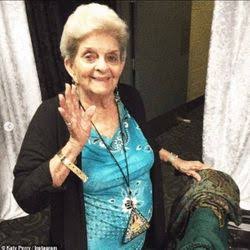
Keith and Mary Hudson
Katy’s parents Keith and Mary grew up in the 1960’s and, according to Katy, had a wild youth:
- Keith made and dealt LSD with Timothy Leary. He was married for a brief time and had a daughter named Jodi.
- while Mary attended Berkeley College. Afterwards she went off to Europe where she married and settled down with her new husband in Rhodesia. But Rhodesia (now Zimbabwe) became unsafe. Having been away for six years, she returned home to California and Santa Barbara in the mid 1970’s alone.
Mary has said that she was saved by Christ in 1977 in Las Vegas. She met Keith while working as a radio news director and freelance journalist there. They married in Las Vegas in 1979.
Their lives changed after Keith had claimed God spoke to him in an apple orchard, inspiring him to become a devout Christian and start an evangelical ministry. They started up their own Pentecostal church in Santa Barbara, California in 1980. They were strict and determined in their calling.
In 1987 they began crisscrossing the country setting up new Pentecostal churches as they went. In 1995, some eight years later, they returned to their base in Santa Barbara. They founded the Christian Oasis Center there before setting up the Life Christian Church just north of San Diego.
In the early years they struggled financially, sometimes using food stamps and even eating food from the food bank which fed the congregation at their church. Their daughter Katy would dutifully attend the Christian schools and camps and sing in their Pentecostal-leaning church. But at the same time she was what she thought “the black sheep of the family.”

However, they later reconciled. And the Hudsons have been regularly introduced to crowds with Katy’s music.
Katy Perry’s Family Tree
- Maternal Perry Line
- Manoele Pereira de Simas m. Thereza Ignaca Jaes in Horta, Azores
- – Francisco Pereira/Frank Perry (1832-1904)
- Francisco Pereira de Silveira/Frank Silva Perry from the Portuguese Azores m. Mary (1835-1923) also from the Azores and came to California around 1860
- – Antonio Perry (1863-1942) m. Sarah Denis
- – Mary Perry (1865-1931) m. Emmanuel George
- – George Perry (1868-1919)
- – Charles Perry (1869-1943) m. Mary Denis
- – Lucinda Perry (1872-1951) m. Manuel Williams
- Vicente Denis from the Portuguese Azores (1827-1902) m. Anna (Hannah) Mulhare from Galway in Ireland (1829-1895) in Sacramento, California in 1864
- – Sarah Denis (1866-1923) m. Antonio Perry
- – Mary Denis (1867-1929) m. Charles Perry
- – Francis (Frank) Denis (1871-1903) m. Daisy
- Antonio Perry from Alameda county, California m. Sarah Denis in San Francisco in 1901
- – Vincent (Vin) Perry (1901-1997), mining engineer with Anaconda, m. Mary Moore in 1926
- – Eleanor Perry (1903-1996), modernist painter of still lifes
- – Frank Perry (1905-1969), stockbroker
- – Mary Perry (1906-1991) m. Jeffrey Yetter
- Frank Joseph Perry Sr, stockbroker from San Francisco m. Pauline Schwab (1908-1965) in New York around 1928, later divorced; rem. Mary Vilsack from Pittsburgh of German descent (1912-1981) in Los Angeles in 1946.
- – Frank Perry Jr. (1930-1995) m. Eleanor Rosenfeld, Barbara Goldsmith and Virginia Ford, film director, with Pauline
- – Vincent (Vin) Perry (1937-2025) m. Elaine Mozes, with Pauline
- – John Perry (1939-1981), US Navy, with Pauline
- – Mary Perry (b. 1947), with Mary
- Mary Christine Perry m. Keith Hudson (b. 1947) in Las Vegas in 1979. They moved the next year to Santa Barbara, California and became Pentecostal ministers.
- – Angela Hudson (b. 1982) m. Svend Lerche
- – Katheryn Hudson/Katy Perry (b. 1984)
- – David Hudson (b. 1988), singer/songwriter
- Katy Perry m. British comedian Russell Brand (b. 1975) in 2010, divorced in 2011; engaged to British actor Orlando Bloom (b. 1977) until 2025; subsequently dating former Canadian Prime Minister Justin Trudeau (b. 1971)
- – Daisy Dove Bloom (b. 2020), with Orlando
- Paternal Hudson Line
- Obadiah B. Hudson from Kentucky (1836-1906) m. Susan Williams (b. 1844) in Kentucky in 1859 and moved to Phillips county, Arkansas in 1860
- – Joseph Hudson (1868-1936)
- – plus six more children – Rosella, Mittann, Imogen, Fred, William and Maggie Hudson
- Joseph S. (Joel) Hudson from Phillips county, Arkansas m. Lula Carlock from Mississippi (1868-1950) in Arkansas in 1893 and moved to Tennessee around 1912
- – Milton Hudson (1895-1961), butcher m. Orlana Ralph, born in Arkansas
- – Guy Hudson (1896-1965) m. Myrtle Willihite
- – Rose Hudson (1900-1982) m. Vivian Hill
- – Robert Hudson (1901-1983)
- – Joseph Hudson (1906-1961) m. Florence Hunt, moved to California
- – Eleanor Hudson (1912-1981) m. Paul Adams, born in Tennessee
- Robert C. Hudson Sr. from Arkansas m. Merla Fleming from Tennessee (1901-1993) in Memphis, Tennessee in 1919 and remained there
- – Robert Hudson (1919-1986)
- – Joy Hudson (1923-2009) m. Boyd Hughes
- Robert C. Hudson Jr. from Tennessee m. Ann Pearl Robison (1921-2020) in Crittenden (near Memphis) in 1938 and moved to Las Vegas after WW2
- – Maurice Keith Hudson (b. 1947)
- Maurice Keith Hudson m. Mary Perry (b. 1947) in Las Vegas in 1979
- – Angela Hudson (b. 1982)
- – Katheryn Hudson/Katy Perry (b. 1984)
- – David Hudson (b. 1988)
Click here for return to front page
Written by Colin Shelley